
Prioritize frequently used incandescent bulbs when comparing LED replacements. Match brightness in lumens, then calculate savings from the difference in actual watts and your hours of use. In a hypothetical 20¢/kWh example, a 60W-to-9W replacement saves about $11.17 yearly at three hours daily, before purchase cost.
If you can replace only a few old incandescent bulbs, compare the lights you leave on longest first. A rarely used closet light can offer much less annual electricity savings than a reading lamp—even when both take the same replacement bulb.
Match brightness, then compare actual watts
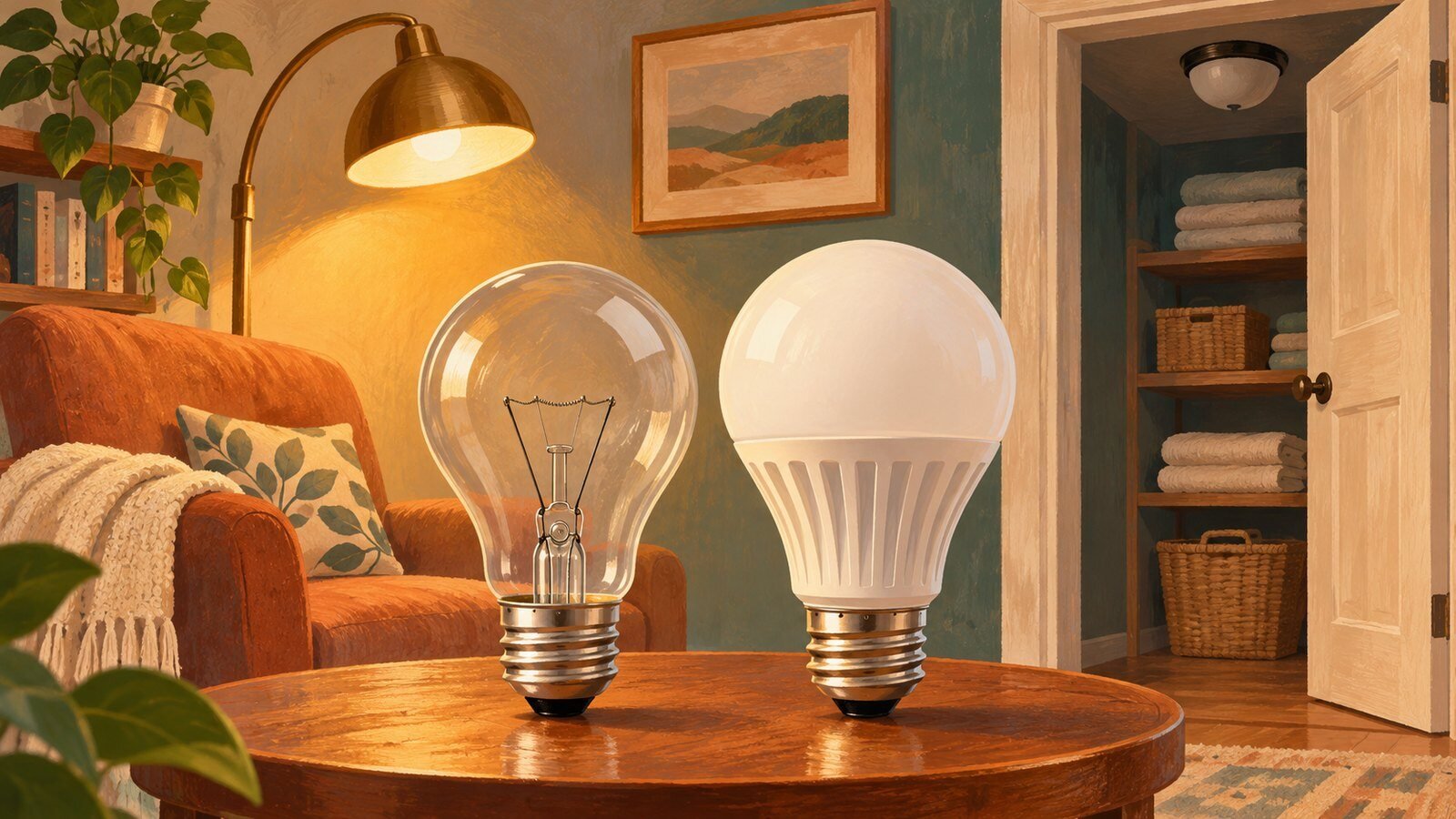
The Federal Trade Commission explains that lumens measure brightness and watts measure energy use. Its example pairs a traditional 60-watt incandescent bulb with an LED that produces the same roughly 800 lumens using about 9 watts.
Use the new bulb’s actual wattage in a cost calculation. “60-watt equivalent” describes a brightness comparison; it does not mean that an LED consumes 60 watts. Check the Lighting Facts label for lumens, watts and warm or cool light appearance before choosing.
The same replacement, two different savings
These hypothetical examples use one 60-watt incandescent replaced by one 9-watt LED, the same hours before and after replacement, 365 days, and a constant electricity rate of $0.20 per kilowatt-hour (kWh). That rate is an illustration, not a national average or a quote from your utility.
| Daily use | 60W annual cost | 9W annual cost | Annual savings |
|---|---|---|---|
| 30 minutes | $2.19 | $0.33 | $1.86 |
| 3 hours | $13.14 | $1.97 | $11.17 |
These are electricity-only estimates, rounded to cents. They exclude bulb purchase prices, replacement lifetimes, taxes, fixed utility charges and any heating or cooling effects. They are not predictions of the change in your total bill.
With identical purchase prices, the frequently used lamp would recover the purchase cost through electricity savings sooner. Compare each bulb’s price with its own estimated annual savings before deciding how much to spend.
Already using LEDs? Check before buying again
An existing LED using 10 watts replaced by a 9-watt model would save only about $0.22 a year at three hours daily under the same assumptions. This hypothetical comparison assumes equal brightness. Replacing a working LED is therefore a different spending decision from replacing a 60-watt incandescent.
Calculate your own shortlist
Virginia Cooperative Extension’s energy-use guide gives the calculation: multiply watts by daily hours and annual days of use, divide by 1,000, then multiply by the electricity rate per kWh. For replacement savings, use the difference between the old and new wattages.
For the three-hour example: (60 − 9) × 3 × 365 ÷ 1,000 × $0.20 = $11.169, or $11.17 a year. Substitute your actual hours and applicable per-kWh rate; if your rate changes by time or usage tier, calculate the relevant portions separately.
Before purchasing, check the bulb and fixture manufacturers’ compatibility instructions. For a dimmer, choose an appropriate dimmer-compatible bulb; the Department of Energy’s lighting guide discusses these specialty LEDs.
Start with one frequently used fixture, record its current wattage and desired brightness, and compare replacement cost against the calculation. If predictable monthly payments are your separate concern, our utility budget-billing guide explains payment smoothing and year-end reconciliation.
Prepared with AI assistance using primary guidance checked November 14, 2026. Hypothetical calculations were checked with code. The featured image is an original AI-generated illustration.

TopicsTalk Desk Editor is the editorial byline for our coverage of U.S. Social Security, Medicare, taxes, and government benefits. Our articles are based on official government publications and include source links so readers can verify important figures, dates, and program rules. We use AI tools to assist with drafting and organizing information. Our publishing process includes checking factual claims against official sources and correcting identified errors. Learn more about our research, verification, and corrections process in our Editorial Policy.