

A larger grocery package is not automatically the cheaper choice. Compare the shelf price per ounce, how much your household is likely to use, and the cash needed at checkout. A worked example shows how unused food can erase a unit-price advantage, while buying enough smaller packs can sometimes cost more.
A bigger grocery package may show a lower price per ounce yet still be a worse buy for a household that cannot use or store the extra food. Start with two questions: how much will you actually eat before the food spoils, and how much must you spend at checkout? Mississippi State University Extension recommends comparing unit prices while also considering whether the larger package can be used, stored or shared.
A smaller pack can be cheaper today, even with a higher unit price
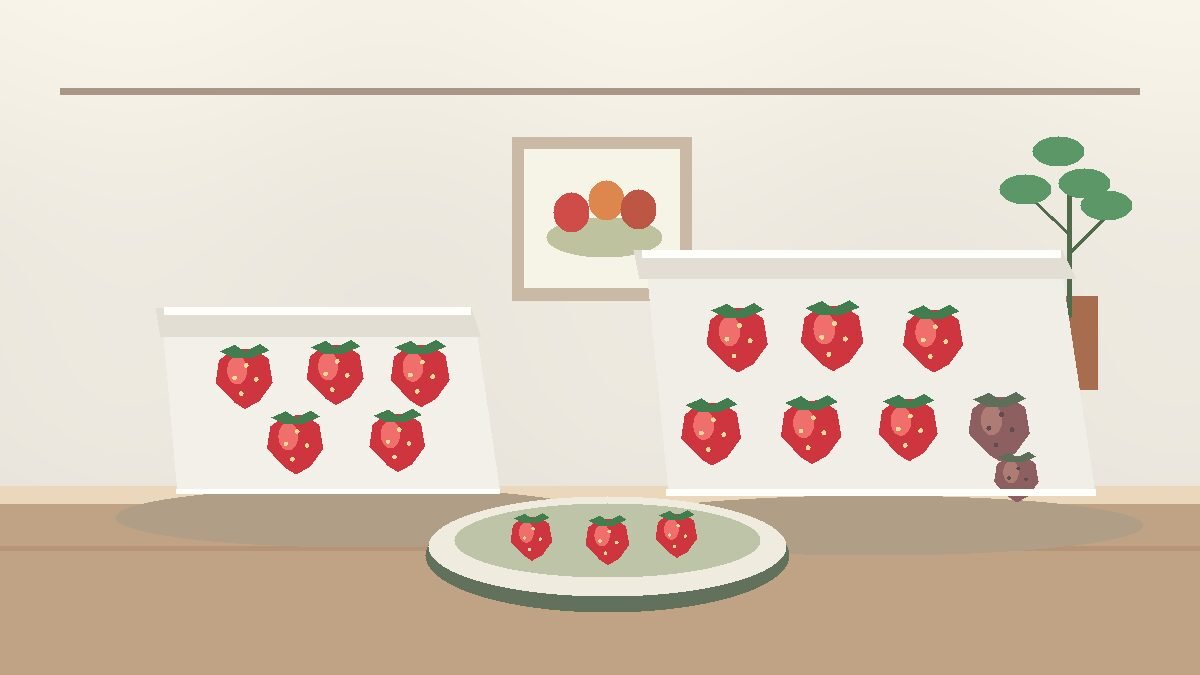
Consider two hypothetical packs of the same strawberries. The smaller container holds 12 ounces and costs $3. The larger holds 24 ounces and costs $5. These are invented comparison prices, not current supermarket offers. The fruit is assumed to be comparable in quality and usable quantity.
| Purchase and use | Checkout cost | Amount eaten | Cost per ounce eaten |
|---|---|---|---|
| Small pack, fully used | $3 | 12 oz | 25 cents |
| Large pack, fully used | $5 | 24 oz | About 21 cents |
| Large pack, 6 oz wasted | $5 | 18 oz | About 28 cents |
The shelf unit prices are $3 ÷ 12 = 25 cents per ounce for the small pack and $5 ÷ 24 = about 21 cents for the large one. But if six ounces of the larger pack go uneaten, you paid $5 for 18 ounces of food you actually ate: about 28 cents per eaten ounce. The shelf comparison did not change; your usable-food comparison did.
The break-even point depends on what you are comparing
For the larger pack to beat the smaller pack’s 25 cents per ounce eaten, more than 20 of its 24 ounces must be used. The calculation is $5 ÷ $0.25 = 20 ounces. At exactly 20 ounces eaten, the effective unit costs tie. This is a comparison of unit costs after waste, not a prediction that spending $5 will cost less at checkout than spending $3.
Actual shopping decisions can point the other way. If you need only 12 ounces, one $3 pack meets that need for $2 less cash than the $5 pack. If you need 18 ounces, and these two package sizes are your only options, you would need to buy two $3 packs for $6, or one $5 large pack. The large pack is $1 cheaper at checkout even if both options leave six ounces unused. Comparing equal shopping needs and whole packages is essential.
These examples exclude taxes, membership charges, storage costs, travel, differences in quality, and the possibility of saving surplus food for later. They also assume the same product and usable weight. A lower shelf unit price is not, by itself, proof of total savings for your household.
Check use and storage before choosing the deal
The EPA’s household food-waste guidance recommends checking the refrigerator and pantry before shopping, planning meals, and writing down quantities rather than just ingredients. For berries and other short-lived produce, ask what you will eat in the next few days, what can be refrigerated properly, and whether a planned recipe can use the surplus.
The FDA cautions against buying large quantities of foods with limited shelf lives when you do not need them. It recommends a refrigerator temperature of 40°F or below and a freezer temperature of 0°F. For item-specific storage and freshness information, use the USDA-developed FoodKeeper tool. Do not assume food is safe solely because an illustrative shopping calculation makes the larger package appear cheaper.
A decision that fits your grocery budget
Before adding the bigger package to the cart, compare the shelf prices in the same unit, estimate how much your household will realistically use, and calculate the checkout cost for enough whole packages to meet that need. For food that stores well or can be frozen safely, a larger pack may work. For something likely to spoil before you eat it, the smaller cash outlay may be the better choice.
Prepared with AI assistance using the cited university and federal consumer resources. The pack prices and consumption amounts are hypothetical, with arithmetic independently recalculated. The featured image is an original conceptual illustration, not a photograph of retail products.

TopicsTalk Desk Editor is the editorial byline for our coverage of U.S. Social Security, Medicare, taxes, and government benefits. Our articles are based on official government publications and include source links so readers can verify important figures, dates, and program rules. We use AI tools to assist with drafting and organizing information. Our publishing process includes checking factual claims against official sources and correcting identified errors. Learn more about our research, verification, and corrections process in our Editorial Policy.